Vilhelm Hammershøi
The Poetry of Silence
People describe Hammershøi’s paintings as quiet. That’s true, but it doesn’t quite explain why they stay with you.
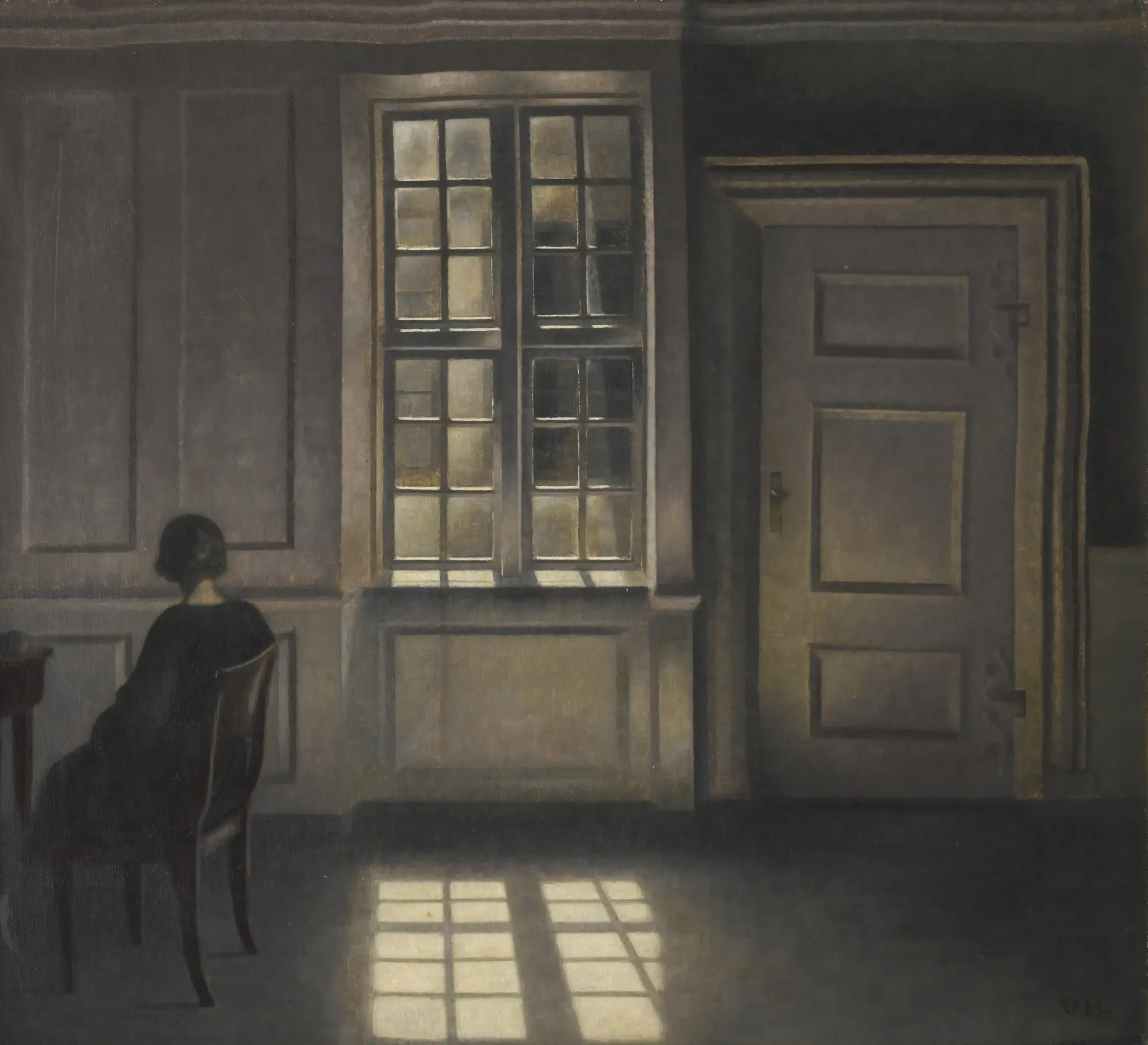
Not much happens in these rooms. A door left slightly open. A chair standing alone. Light moving across a floor and stopping. And yet they never feel empty. There’s a presence in them that has nothing to do with what’s depicted.
These aren’t paintings about domestic life, at least not in any comfortable sense. There’s no warmth here, no suggestion of the household continuing just out of frame. The furniture is plain. The palette is so muted it almost disappears. What remains is structure and light — and a stillness that feels less like absence and more like something chosen.
The doors suggest someone might enter. No one does. The windows admit light but reveal almost nothing of the world beyond. We are left inside, alone with the space, and the space doesn’t explain itself.
That’s what makes him unusual. Most paintings ask to be read — for a message, a narrative, an emotion to be identified and carried away. Hammershøi asks for something harder. Patience. The willingness to stay in a room that offers no resolution and find that the staying itself is the point.
It can feel uncomfortable at first. We expect art to give us something to hold onto. He offers instead an existence that needs no explanation — the feeling that something is present, even when nothing appears.
His work asks a quiet question. Whether we can sit with stillness without filling it. Whether a space that refuses to become a story is something we can bear.
Most of the time, once you’ve adjusted, you find that you can. And that you don’t want to leave.