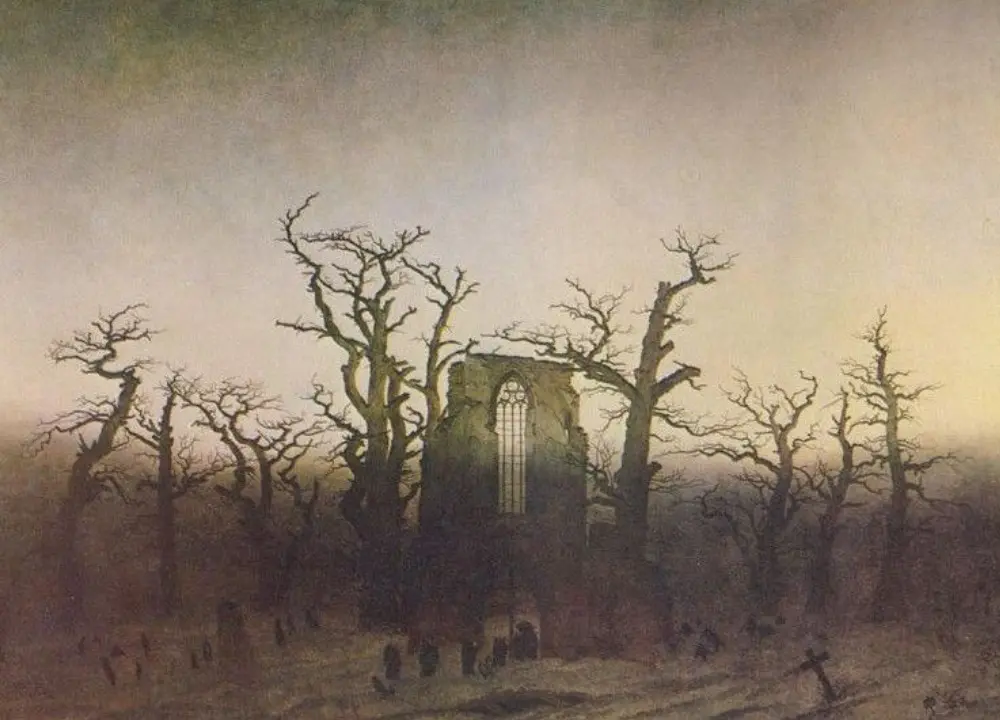
Caspar David Friedrich
The Architecture of Solitude
There is always a figure standing with their back to you in a Friedrich painting. Looking out. Away from you, toward something you can't quite see.
That distance is the whole point.
Friedrich wasn't painting landscapes. He was painting states of mind — the feeling of standing at the edge of something vast and understanding, quietly, that you are very small within it. The German Romantic movement found its visual language in his work because he understood that the external world could be made to carry interior weight.
His figures don't command the landscape. They are absorbed by it. A solitary shape against a rising moon, at the rim of a cliff, before an expanding horizon. Nature doesn't acknowledge them. It simply continues — indifferent, enormous, and in that indifference, somehow more honest than anything human.
He returned repeatedly to ruins. Abbeys stripped back to their arches, gothic windows open to the sky, oaks bare and reaching upward like the bones of something that was once a cathedral. These aren't picturesque details. They're arguments. Stone erodes. Timber rots. Whatever was built here, time has been working quietly against it, and time is winning.
The light in his paintings is never comfortable. Dawn that is too pale. Twilight that has already stayed too long. Moments where time seems to have paused without your permission, and the stillness asks something of you that you can't quite name.
Friedrich's landscapes are thresholds. The visible world, rendered carefully — and then, at the edge of it, the suggestion of something that careful rendering cannot reach.