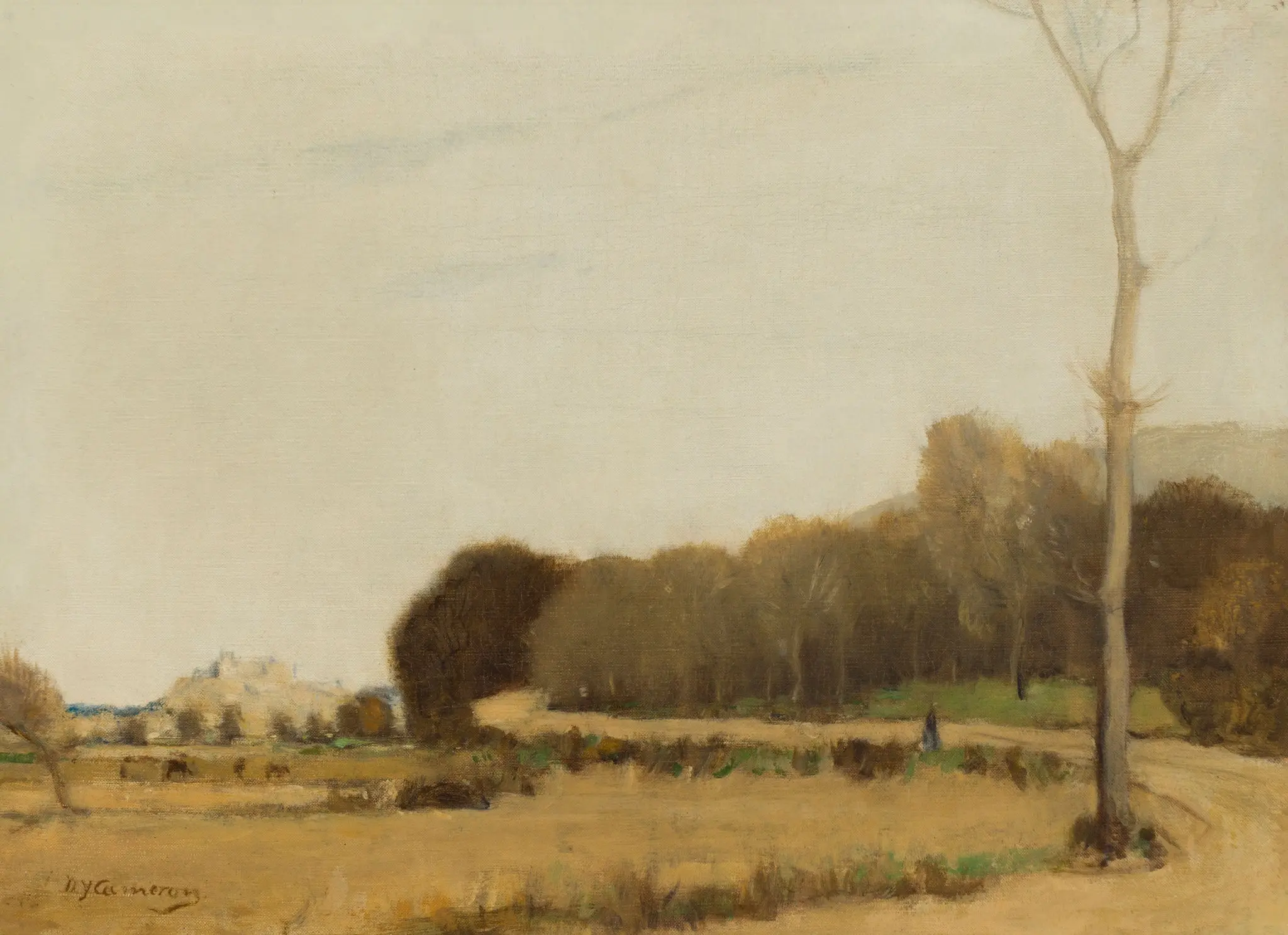
David Young Cameron
What Remains
Stone doesn't disappear. It reduces. Slowly, over centuries, under weather and neglect and the indifferent pressure of time, it gives ground — but it gives it reluctantly. What Cameron painted, again and again, was that reluctance.
He was drawn to the places where human presence had thinned down to almost nothing. Abbeys open to the sky. Towers standing without the buildings that once surrounded them. Hillsides where the only evidence of habitation is a change in the quality of the silence. He painted Scotland and the north with the eye of someone who understood that the landscape there is never simply natural — it has been worked, and fought over, and abandoned, and what you're looking at when you look at an empty hillside is the long aftermath of all of that.
His technique was etching as much as painting, and it shows in how he saw. Hard edges. The precise weight of shadow against stone. He didn't soften what he looked at the way Corot might, or dissolve it the way Inness would. He let it be angular and enduring and cold. The harshness wasn't something to paint around. It was the truth of the place.
But there is feeling in these paintings, running underneath the austerity. These ruins were built by people who believed they were building permanently. The abbey at Glenluce, the tower on the ridge, the wall that ends nowhere — someone quarried that stone, dressed it, lifted it. Believed in what they were making. Cameron paints what time has done to that belief without editorialising about it. He simply shows you what's left.
What's left is enough. More than enough. The stone that remains carries everything the missing stone once supported — the weight of what was there, the shape of the absence. You don't need the complete structure to feel the scale of the loss. Cameron understood that, and trusted you to understand it too.
Time acts on everything. Stone just makes the acting visible.